Magic Data Magic Data
×
DigitalOcean
Go To Page 1 ->
Acquisition Brief · Page 02

What Magic Data does, how it thrives inside DigitalOcean, and what it requires.

Three example deployments. Five integration surfaces inside the DO console and API tomorrow. One containerized stack that drops cleanly onto Droplets, App Platform, or Managed Kubernetes — and a bring-your-own-model posture that mirrors the Inference Engine.

1. Example use cases

Use case · 01
Anomaly Detection

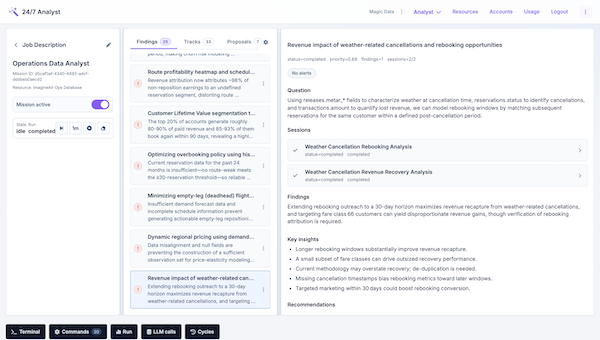
Magic Data prepared an anomaly detection workflow for a supply chain inventory platform that surfaced unusual patterns across spend, volatility, supplier concentration, delivery performance, and onboarding trends. Those outputs gave the customer success team account-specific renewal and upsell narratives they could take directly into commercial conversations, turning raw operational data into actionable revenue moments.
Use case · 02
Data Quality

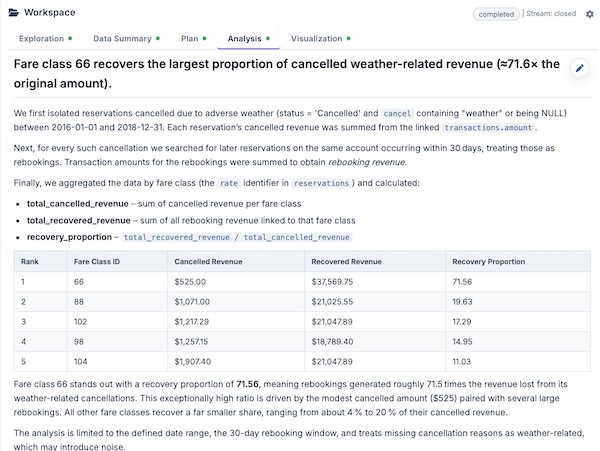
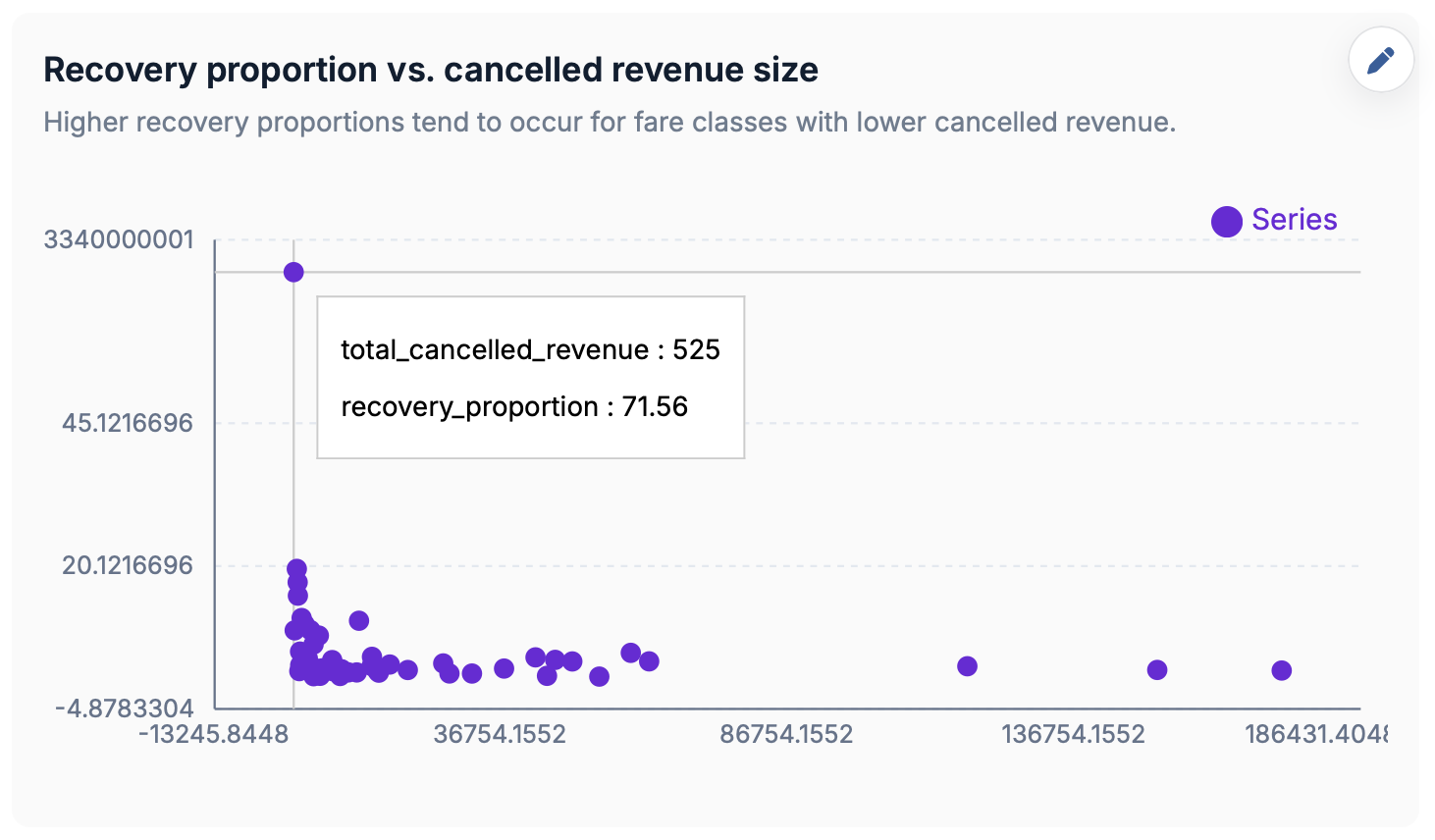
Magic Data was also run against production records from a charter airline, where it behaved like a data architect embedded inside the workflow. It identified architecture gaps, weak transformations, missing aggregations, and modeling opportunities that could support revenue recovery, operational reporting, and downstream agent reliability.

Use case · 03
DBA / Data Operations

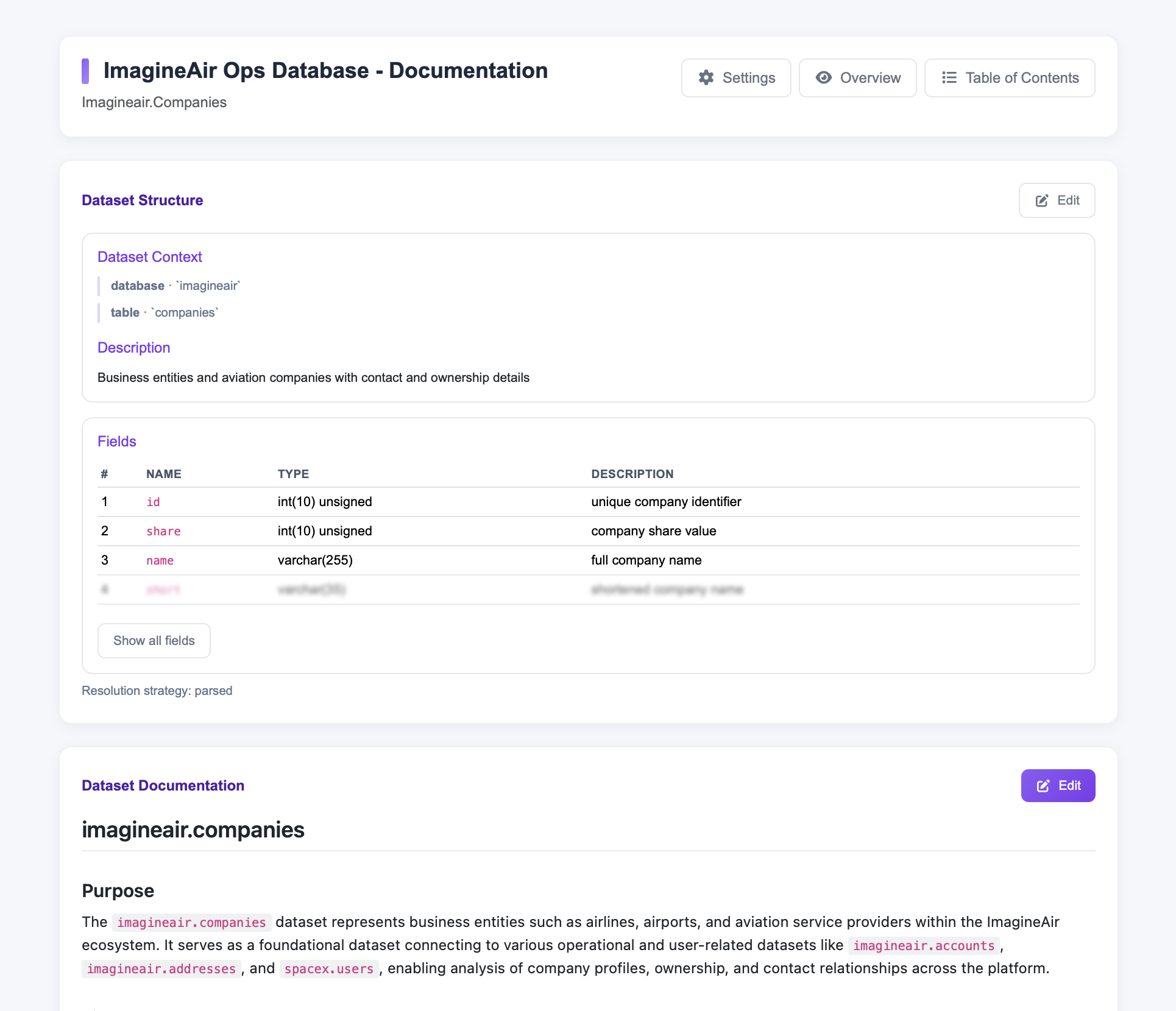
Magic Data's documentation and topology layer can support agent workflows that need persistent domain understanding of an underlying dataset. That makes it useful not only for detecting corruption, schema drift, and broken assumptions over time, but also for powering agents that generate SQL transformations, ETL logic, or database maintenance recommendations.

2. How Magic Data could live inside DigitalOcean

DigitalOcean already offers both point-and-click product experiences through the Control Panel and programmatic management through its API, which creates a natural packaging model for Magic Data: one-click for adoption, API-first for automation and enterprise workflows. That combination is especially relevant across Managed Databases, Knowledge Bases, GenAI agents, Functions, App Platform, and Kubernetes-based deployments.

a
Integration surface · DBaaS
Automated one-click data documentation on Managed Databases

When a customer provisions PostgreSQL or MySQL through DigitalOcean Managed Databases, DigitalOcean could offer a one-click "Document My Data" action inside the Control Panel. DigitalOcean already emphasizes that database clusters can be launched in a few clicks and then managed through either a simplified UI or API, which makes this a highly native activation point.

That action could trigger Magic Data agents to explore the schema, infer relationships, map semantic dependencies, and synthesize a topological understanding of how the customer's data is actually organized. The resulting outputs could include:

  • A long-form written data catalog.
  • An interactive ERD and relationship map.
  • A machine-readable context layer that downstream agents can immediately consume.

A second phase could expose the same workflow through API endpoints so teams can auto-run documentation after database creation, after migrations, or on a recurring schedule. That matches DigitalOcean's broader pattern that Control Panel actions are also available programmatically through the API.

b
Integration surface · GenAI · KB
Embeddings for managed agents and knowledge bases

Running Magic Data’s discovery process first gives DigitalOcean’s managed agents a structured understanding of tables, entities, joins, metrics, and business concepts before any reasoning begins. This aligns directly with DigitalOcean’s GenAI platform, where agents integrate with knowledge bases, functions, routing, guardrails, and retrieval pipelines.

Instead of requiring manual context assembly, Magic Data generates agent-ready embeddings and schema-aligned metadata, depositing them into DigitalOcean-supported retrieval layers such as PostgreSQL (pgvector), knowledge base pipelines, or other open integrations. DigitalOcean’s Data & Learning layer—spanning knowledge bases, managed databases, and tools like pgvector, Qdrant, Chroma, MySQL, and Valkey—makes this a natural product extension, not a speculative one.

This enables production-ready agent experiences (e.g., travel workflows or vertical assistants) by giving agents a usable map of the customer’s data environment rather than raw access.

c
Integration surface · Console agents
Always-on agents inside the DigitalOcean console

Magic Data could power always-on operational agents inside the DigitalOcean console, starting with high-trust use cases like Data Quality, Integrity, and DBA monitoring. These agents would run across managed or connected data sources, detecting schema drift, join issues, null spikes, freshness gaps, and metric anomalies.

This aligns directly with DigitalOcean’s GenAI model—managed agents paired with knowledge, functions, and retrieval—while leveraging its stack: serverless inference, Functions, and app or Kubernetes runtimes.

Over time, this can expand into business use cases like pricing optimization, anomaly detection, and account intelligence.

A clean packaging model:

  • Point-and-click enablement in the Control Panel
  • API provisioning for partners and enterprise customers
  • Functions-triggered jobs for scans and refreshes
  • App Platform or Kubernetes for long-running agents
d
Integration surface · NL Analytics
Ad hoc analytics inside the DO console

The GenAI platform already lets customers build agents with retrieval, guardrails, and Knowledge Bases, and exposes an Agent Playground for experimentation. Magic Data Sessions can extend that surface by giving users a natural-language analytics interface inside the console that operates over their Managed Databases and Knowledge Bases with topology-aware context.

A DigitalOcean user could, for example:

  • Ask "Where did unit economics degrade last quarter?" and get a structured explanation, with SQL queries and chart outputs grounded in the documented schema.
  • Ask "Which supplier cohorts have the highest volatility across regions?" and see the underlying logic as well as the visualizations.

Because Magic Data knows how the data is related and how metrics should be computed, the answers are more trustworthy and repeatable than generic RAG over raw tables. For DigitalOcean, this builds a bridge from infrastructure management to lightweight analytics without turning the console into a full BI product.

e
Integration surface · Visualizations
Data visualization inside the DO console

DigitalOcean's AI-Native Cloud emphasizes "production workloads" and "agent-native systems that run autonomously over long cycles," not just one-off demos. Magic Data Sessions can support that narrative by enabling fast, scenario-focused dashboards directly in the console:

  • A "Data Quality Scorecard" produced in minutes for a newly created Managed Database.
  • A "Renewal Risk" dashboard for a SaaS customer's own users, powered by anomalous patterns detected in their data.
  • A "Pricing Optimization" view for e-commerce or marketplace workloads running on DigitalOcean.

Under the hood, the system would generate both the data logic (SQL, transformations) and the visual layer. DigitalOcean can frame this as targeted operational intelligence around customers' own workloads rather than attempting to replace existing BI tooling.

This would extend DigitalOcean beyond infrastructure and model access into a more opinionated operational intelligence surface. Because DigitalOcean already provides managed application, function, storage, and AI building blocks, the pitch here is not that DigitalOcean needs to become a full BI suite, but that it can offer targeted, high-value visual intelligence natively around the data already living on its platform.

3. Features and requirements

Req · 01 / Compatibility
Broad SQL compatibility, immediate DO fit

Magic Data is built to operate across diverse SQL environments, with out-of-the-box support for engines such as Snowflake, BigQuery, Redshift, MySQL, and PostgreSQL. For DigitalOcean, the natural starting point is Managed PostgreSQL and Managed MySQL — particularly the new Advanced Edition tier built for hyperscaler-grade reliability and scale — with a roadmap to expand into additional managed engines and retrieval surfaces.

Req · 02 / Deployment
Containerized deployment aligned with DO primitives

Magic Data ships as a containerized stack that can be deployed via a single command, with a minimal footprint that runs on a single VM and a clear path to separate services as scale, compliance, or security requirements increase. That makes it straightforward to run on Droplets, App Platform, or Managed Kubernetes clusters, and to integrate with DigitalOcean's networking, storage, and security primitives.

Req · 03 / Models
Bring-your-own-model, consistent with the Inference Engine

Magic Data's Profiles feature supports bring-your-own-model routing, allowing customers to combine API-hosted models with self-hosted ones. This aligns with DigitalOcean's Inference Engine and GenAI platform, where customers can use serverless inference, dedicated inference, and a broad model catalog — including BYOM — all routed through a policy-aware Inference Router.

Req · 04 / Packaging
Point-and-click for adoption, API-first for scale

The same capabilities can be exposed as:

  • A one-click "Document my data" and "Enable data agents" experience in the DigitalOcean Control Panel for Managed Databases and GenAI customers.
  • A set of API endpoints that let teams trigger discovery, documentation, embedding refreshes, and topology exports from CI/CD pipelines, Terraform, or other infrastructure-as-code tools.

This dual mode mirrors how DigitalOcean already presents its AI and infrastructure products: approachable in the UI, and fully programmable for teams that want to automate.